Stock Disciplines, LLC


Home
Subscriber Section
Product List
Market Review
Alerts
Price Surges
Momentum Scan
Strongest Stocks
Strongest Utilities
Strongest ETFs
ETF Signals
Stock Alert Videos
Stock Alerts
Breakouts
Stock Scanner
Volatility Stop Loss
Stops Video
Stops
Valuator Videos
The Valuator
Notes
Free Tutorials
About Us
Contact Us
Testimonials
Fees & Refunds
FAQ
Privacy/Security/Terms
Index

A Discipline Of The Strongest ETFs

.
Your access to the Strongest ETFs List in rank order begins here. 
Below, we give strategies for creating an ETF portfolio based on these lists.  Our strength rank algorithm goes far beyond the simplistic Relative Strength RSI used at other Web sites.

Go to ETF list
 

"Strength" & "The Strongest"

When we say a stock or ETF is "strong," we are referring to strength that goes far beyond that measured by the Relative Strength Index (RSI), a mathematical tool popular with traders.  The Relative Strength Index is an oscillator that ranges between 0 and 100 and is based on the ratio of upward price changes to downward price changes over a short period of time (usually 14 days).  Our own strength indicator is far more sophisticated.  If you scan 2000 stocks with the Relative Strength Index, you will find that many of the stocks that rank high are not really attractive because of overhead resistance or because the surge of strength measured is not really significant for some other reason (a non-significant rebound in a very unattractive or threatening chart pattern).  The list selected by our own strength screens, however, will look much more attractive.  The more stocks that are screened, the greater the difference will be in the quality of output.  To see an illustration of how the output of the two systems can differ, click on the "Strongest Stocks" tab on the navigation menu.  We use the same algorithm there and we have included some charts for comparison purposes.  When you look at our highest ranked "strength" stocks, especially when they are selected from among hundreds of stocks, you will know you are looking at stocks that are very strong.  

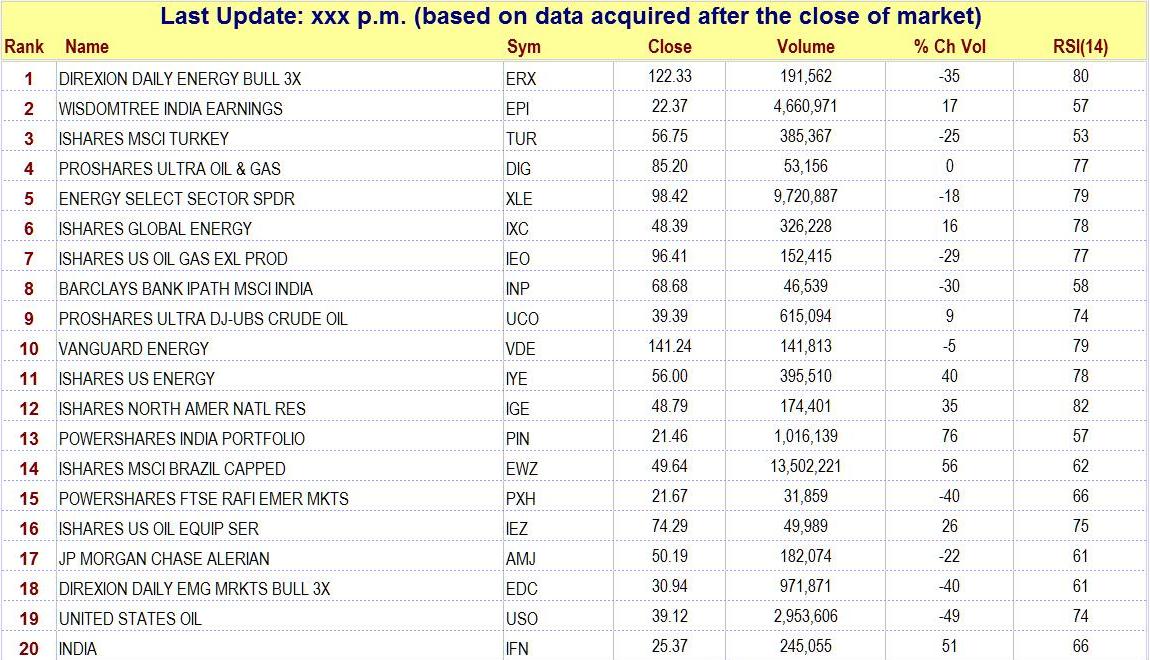
Because ETFs have become so popular, investment houses have been in a mad rush to churn out new ones in an attempt to profit from the craze.  In order to do this, they are focusing on narrower and narrower market niches.  This is a great marketing ploy because they can argue "we have it all...do all your shopping here."  Much of this stuff is pure junk and not worth considering.  Currently, there are hundreds of ETFs.  Many of these trade only a few thousand shares a day.  Some trade only a few hundred.  Low trading volume means low liquidity.  That means it can be very difficult to trade quickly when you want to buy or need to sell.  Low volume also means a person is likely to pay more when buying or get less when selling.  The price differential can easily add up to the equivalent of a "sales load."  Our universe of candidate ETFs consists of the more actively traded (higher daily volume) ETFs.  This universe is then subjected to our "strength" algorithms (compare 50 stocks selected by using the Relative Strength Index with those selected by our own strength filter.  The difference will be quite obvious).  The ETFs we post in our ranking list will be the "strongest" 50 at the time of posting (ranked in order of strength).  This list can also serve as a "Market Monitor" because it indicates which markets and sectors are "hot" here and abroad.    

.

Strategies for Using the List

Please remember that our reports do NOT constitute a recommendation that you personally buy or sell any securities.  In the following discussion the words "buy" and "sell" refer to imaginary transactions in a theoretical portfolio and not to transactions in a real account.  The word "you" is used for editorial purposes only and does not refer to you personally.   

You could use our lists several ways.  For example, you might put the more attractive ETFs on a "watch list" and review their charts daily, waiting for one of them to decline to its rising trendline.  Then, as it begins to rebound off this support line on increasing volume, you could buy it for your portfolio.  Your sell strategy might consist of selling any ETF that falls below its supporting trendline.  Or, you might sell if it drops out of the top 30 in rank.  For example, you might buy the top 5 ETFs and sell any that fall out of the top 30.  Then you could replace it with one of the top 5 that you do not currently have in your portfolio.  For your convenience and for easy reference, the ETF ranked number 30 is posted in bold or blue letters.  This concept is quite flexible.  You might sell when an ETF falls out of the top 10, top 20, top 50, or whatever.  You could build your portfolio around 5, 7, or 10 positions, based on your portfolio size, investment needs, objectives, and tolerance for risk.

There are many ways you could define your selling strategy.  You could sell any ETF that drops 5%, 7%, 10% or some other percentage below your purchase price, or below the highest high, low or close reached by the ETF since its inclusion in your portfolio. Alternatively, you might combine strategies so that a sale occurs if an ETF falls out of the top 30, if it declines 8% since its inclusion, or if it falls 10 levels (or some other amount) in its ranking. Of course, some of the strongest selling disciplines factor in the volatility of a stock or ETF.  For example, when the decline of a stock or ETF is such that there is only one chance in a hundred that it would fall that much "by chance" or as a result of its "normal fluctuation" given its current level of volatility, a sale might be appropriate (because it represents a move beyond the "normal probability envelope" for price spikes).  This is where the Stops tool can be a big help.  Click on Stops (on the navigation bar or in the set of links at the bottom of this page) for more information on this. 

Other strategies might be to select those from among the top 30 (or from a larger or smaller subset of the top 50 listed) that look the most "timely" (the most likely to move up soon) or to select those that have just moved up in rank (a move up in rank suggests new momentum or an increase of public interest in that market or sector).  Sometimes a stock that is highly ranked might not be as attractive as a stock that is not ranked as highly but that is more likely to rise soon from current levels (perhaps because it is nearer to support or in the process of rebounding from support).  An important consideration here is your anticipated holding period.  Short-term traders will want to capture their gains quickly.  That means they will be a little more "picky" about the ETF's "setup" and the timing of the purchase.  Whatever method you use, your selections could be limited to those ranking among the 30 strongest ETFs.  A portfolio that is always invested in the top 30 ETFs should do quite well over time.  We would expect it to perform much better than most of the better performing mutual funds.  (Note: there is a discussion of the meaning of "support" and "resistance" that can be found by clicking on "Free Tutorials" on the navigation bar and scrolling down to the section titled "Charts."  Read all of that section.)

Unless you have selected a strategy that requires it, it is not necessary to monitor an ETF portfolio on a daily basis.  Portfolio adjustments can be made once a week or once a month, depending on your strategy.  We once managed a utility portfolio strategy that required adjustments only once a quarter, and its average annual return was about 20% a year for over 15 years after fees and expenses.  Those who are bent on obtaining the highest level of performance might want to fine-tune their entry points for new positions by monitoring the charts of purchase candidates (their "watch list") each day after the market's close.  Once they make their purchases and set their stops, they could then make weekly rather than daily reviews.  Others will simply look at the charts of highly ranked ETFs once a week and make their decisions on the basis of their weekly reviews.  Of course, there are also those who will want to monitor their portfolio on a daily basis. 

There is another obvious way to use the ETF rank list.  You might want to find out what sector is ranked the highest so you can begin your search for stocks in that particular sector.  That is, the list could function as your preliminary scanner.  For example, you could narrow your search for strong stocks to those that are included in the top five ranked sectors.  

The strength algorithms used in generating the list are the same as the ones used for The Valuator's "STR RANK" (Strength Rank) measurement and in its "Highest Strength List."  We have said that the calculations are far more complex than the simple RSI Index calculations used to measure "strength" at most Web sites.  Lists based on the RSI are much more likely to have "setup" problems.  Our strength model is proprietary.  However, to give you an idea of what we mean by "more complex," we will say that it requires 6 algorithms for the first sort and then 3 more algorithms are applied to the results of the first sort to derive the final scores.  The results of the latter are then ranked and the top 50 are listed here.  Before purchasing an ETF, you should look at its chart.  To see a few Web sites where you can generate free charts, click on "Links" at the bottom of our Home page then click on "Outside Help."   

Previously, we listed the strongest ETFs in rank order on this page.  However, we have decided to provide a different free list on this page (keep reading).  The complete list of the top 50 ETFs displayed in rank-order is still available, but we have moved it to another location on this site.  Our algorithm is proprietary and it is far more effective than the Relative Strength Index (RSI) at finding securities that are really strong.  If you haven't already done so, we urge you to use the "Strongest Stocks" tab on the navigation menu to see some charts that illustrate the difference between the selections made by using the RSI and those made by using our algorithm

It took time and effort to test and perfect our algorithm, and it is available nowhere else on the Internet.  Unfortunately, the costs to operate a Web site are greater when a site provides unique content (we do not obtain our content through the use of "cookie cutter" uploads and we do not clutter our site with third-party advertisements).  Therefore, in order to get a modest return for our efforts, we have decided to charge an annual fee of $85 for the complete list of the 50 highest ranked ETFs arranged in rank order and updated daily.  You may be able to find free lists elsewhere on the Internet, but those lists will almost certainly be made by using the RSI.  [It is standard practice to use the RSI to find strength in stocks because it is a cheap, quick, and easy pre-packaged upload for Web sites that do not have the mathematical expertise necessary to create more effective screening algorithms.   At Stock Disciplines we do our own "number-crunching," model creation, system testing, and algorithm development.]  The RSI will often rank an ETF highly even though it has a terrible chart configuration and dominating overhead resistance nearby while completely missing an ETF with a much better chart pattern or even a pre-surge "setup" and more persistent strength.  Our algorithm avoids that problem.  Its lists actually do consist of the ETFs with the greatest persistent strength arranged in rank order.
 .

Free List of Selections From the Top 50
Updated Daily

ETFs are ranked relative to each other.  If there are no strong ETFs, a list will still be generated that consists of the strongest ETFs in a weak ETF universe.  The following list of 10 ETFs is taken from our large list of ranked ETFs.  Though all of these ETFs rank among the currently strongest 50, they are not arranged in rank order for strength.  A given ETF below may be from the top of the strongest 50 list or from the bottom.  Some of the ETFs included in this list may not be included the following day.  If an ETF vanishes from this list, it may simply have changed its ranking a little, or it may no longer be in the top 50 because it has been displaced by other ETFs that are stronger.  We believe that a number of our visitors like to see where pockets of strength are in the stock market or to see which markets around the world are among the strongest, and knowing which ETFs are among the strongest is one way of doing that.  They use the information as a guide in their hunt for stocks in strong sectors or geographical regions.  The following list should be of interest to those investors.  It will also be of interest to ETF investors who simply want a few ideas about what is currently strong.

This List Was Updated Mon p.m. for Tue a.m.

February 8, 2010

Sym

Close

KBW Regional Banking

KRE

22.85

Russell Midcap Value i

IWS

35.390

S&P MidCap 400 BARRA Value i .25

IJJ

63.310

Russell 3000 Growth i

IWZ

38.352

Cohen & Steers Realty Majors

ICF

48.210

S&P SmallCap 600 BARRA Gro i .25

IJT

53.420

Powershares Biotech & Genome

PBE

16.800

DJ US Real Estate i

IYR

42.580

Rydex S&P Equal Weight

RSP

37.700

Vanguard Small Cap VIPERs

VB

54.310

Some ETFs may have a number after their name (.25, .90, etc.).  These numbers were once used for internal purposes.  Please disregard them.  We plan to remove them eventually. 

The above list is for those who have a more casual interest in pockets of strength in the ETF universe.  On the other hand, our detailed list of the top 50 ETFs arranged in rank order and updated daily is for those who want to take a disciplined and consistent approach to creating a high-performance ETF portfolio.  The selection and ranking power of its algorithm does a far better job of finding persistent strength than anything else available on the Internet.

More...

.

Links To Other Places On This Web Site   

Home    Market Review   Alerts   Price Surges   Stock Scanner   Momentum Scan   Strongest ETFs   Breakouts   Strongest Stocks   Tutorials  

Stop Losses   Stops   Products   The Valuator   StockAlerts   Trading Tools   About Us   Contact Us   Fees & Refunds   Links   Index   
.
.

. All pages on this Web site are protected by copyright
Copyright 2010 by Stock Disciplines, LLC
No part of this publication may be reproduced or distributed in any form by any means.
.
.
"But thou shalt remember the Lord thy God: for it is he that giveth thee power to get wealth."  Deut. 8:18
.

Trading and/or investing in the securities markets involves risk of loss. This Web site NEVER recommends that ANY individual buy or sell ANY securities.  It does not give individual investment advice, and nothing herein should be interpreted as if it does. Readers of this site's content should seek advice from a licensed professional regarding their personal investments. Stock Disciplines, LLC will not be responsible for any loss that results from using information provided on this Web site.

By using this site, you agree to our Terms of Use and Privacy Policy.  These may
be accessed by clicking on the "Privacy/Security/Terms" tab near the bottom
of the navigation menu located on the left side of every page.