
Stop Loss Strategy
A Stop Loss Triggered Too Soon?
Strategy Update
The following “Strategy Update” was sent to people who were subscribers to the Tiger ETF model a number of years ago. This is a program that is not presently open to new subscribers. It was not the high-powered “Disciplined Growth Strategy” that our own traders use and that has been mentioned elsewhere on this site. The reason it is included in our list of tutorials is that the comments are informative about disciplined trading considerations. It has not been edited, except for the inclusion of the last sentences (bold and italicized).
Stop Loss Strategy
The Tiger ETF model is off to a great start! It commenced operations on February 1, 2006. The model’s portfolio valuation was $100,000. In the 52 days since the inception of the program (as of 3/24/06), the model portfolio has gained $3,909.69 (net) or 3.91%. If the model can keep up its current pace, it will return over 27.4% for the year. During the same period, the S&P500 appreciated 1.597%. If the market can keep up that pace, it will appreciate about 11.2% for the year. Please recall that the targeted growth rate of the model is between 18% and 25%. This is somewhat stronger than the growth rate of our old Optimized Utilities Portfolio program that averaged about 20% a year for 15 years. So far, the Tiger ETF model has more than doubled the performance of the market. Given the fact that the ETFs invested in by the model represent so many different sectors in our market and so many other markets around the world, it is likely to continue to outperform. Even when our own market is declining, there is almost always a market or sector somewhere that is rising. Remember that ETFs trade just like any stock and trade commissions are the same as for regular stocks (the brokerage commission is only $10.99 for a purchase, regardless of the number of shares in the trade).
One subscriber recently commented that the stop-loss settings of the model seem rather distant from current prices. The model uses the volatility and support levels of a security to determine stop-loss settings. The model has several ways of determining how far a security is likely to drop because of mere “noise” in its behavior. The model “wants” the stop-loss to be triggered only if there is a significant and meaningful change in direction. Therefore the stop-losses are usually set outside the normal excursions of the stock but close enough that a meaningful decline will trigger a sale. No stop-loss system is perfect. For example, look below at the chart for the Switzerland ETF.
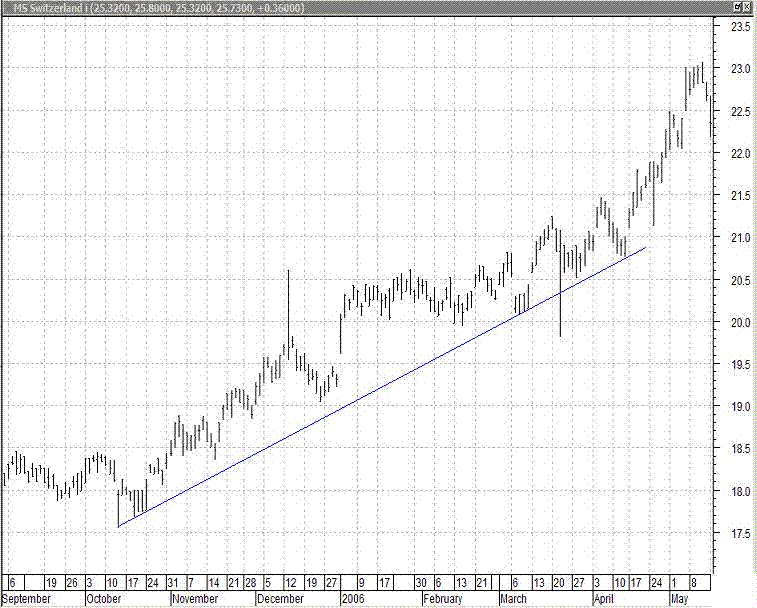
The stop-loss was set below the trend-line at 20.38. Because this trend-line represents significant support for the stock, it should not have dropped below the line. However, it took a plunge to 19.81 on March 22nd, triggering a stop-loss sale. Normally, that much of a drop would be only the beginning of a much larger decline. The line shows us where significant numbers of buyers are so interested in the stock that they quickly buy up all the shares that sellers are willing to relinquish. Buyers are more anxious to buy than the sellers are to sell. That is why the line is rising. Since the stock has not really changed its direction yet, the triggered stop-loss was probably the result of “noise.” Even so, it was an event outside the probability envelope of the security’s behavior history. The same thing almost happened with the Malaysia ETF. If the model had placed the stop-loss even one cent higher, the position would have been sold, and then the security would have continued its upward course. The stop-loss was set at 7.13. The stock dropped to 7.14 on March 15th. The algorithms of the model are very good at estimating probable non-significant excursions (excursions that are not the beginning of a change in trend direction).
The correct placement of stop-losses is a tricky endeavor. The Tiger ETF model that generates the reports we send to subscribers does not use tighter stop-losses in order to avoid higher levels of trading activity. However, a subscriber to the other model can ask for the tighter stop-loss settings generated by the discipline for any security, including any ETF. These are also based on support levels and on the volatility of the security. The closer stop-losses simply have a higher probability of being triggered. For shorter-term traders, this can be a good thing.
We are very pleased with the performance of the model. It does not generate an excessive amount of trading activity, yet it performs at a very high level. At the same time, the stop-loss disciplines help keep risk under control.
Comment. The trendline was violated in one big spike, then the stock continued moving along the trendline with no other incidents. This was not common behavior for the stock. It had no pattern of breaking trendlines. It is an example of the fact that no matter how well you plan, there will be times when you take a hit. If you plan well, the hit will be very small. These inconveniences are part of the trading and investing experience. While it is true that a person could have held rather than sell, this conclusion relies on hind-sight. Selling was the right thing to do given the magnitude of the plunge. If you take the wrong lesson from this (“it would have been better to keep holding, because the stock recovered almost immediately afterwards”), you may develop poor habits and end up holding when you should not, resulting in too many losses that are too large. In this case, the stop loss limited the loss to a very small amount (certainly much less than would have been possible given the depth of the stock’s dive). ~ Dr. Felt